A standard 2,000-point game of Warhammer 40,000 is played on a battlefield measuring 44 inches by 60 inches. That is the answer most people come looking for. The harder question is what that battlefield does to a room once the table under it becomes real furniture.
One person in the household wants to know whether a 6x4 board still works. The other wants to know whether the dining room stays a dining room between games. Most guides stop at the first question.
The short version: a 44 by 60 inch surface plays a full game of 40k. A 6 by 4 table plays it more comfortably and covers more systems. Whether either belongs in your house comes down to about three feet of walking space on every side.
Official Warhammer 40k Table Sizes
Games Workshop scales the battlefield to the size of the game. These are the current dimensions under 11th Edition, carried over unchanged from 10th.
|
Game size |
Points |
Battlefield |
|---|---|---|
|
Combat Patrol |
~500 |
44" x 30" |
|
Incursion |
~1,000 |
44" x 30" |
|
Strike Force |
~2,000 |
44" x 60" |
|
Onslaught |
3,000+ |
44" x 90" |
|
Apocalypse / large narrative |
varies |
8' x 4' and up |
Every one of those numbers describes the marked play area. The furniture underneath is a separate measurement, and it is almost always bigger. That gap is the first thing we account for in the tables we build for Warhammer.
44 inches by 60 inches is the tournament default and the number most players are planning around. Combat Patrol and Incursion share the smaller 44" x 30" board, so games up to 1,000 points ask for barely half the surface. Onslaught at 44" x 90" adds half again the length of a Strike Force board, which is why it usually means two tables pushed together rather than one enormous one.
Cross-system players get a break here. Age of Sigmar uses the same 44 x 60 inch battlefield at standard size. Kill Team, Warcry, and Age of Sigmar Spearhead all play on 22 x 30 inches, small enough for a coffee table.

Why the Standard Changed From 6x4
Through 8th Edition, the classic board was 6 feet by 4 feet, or 72" x 48". Ninth Edition introduced the narrower 44-inch width in 2020 and scaled board length to points instead of holding one size for everything.
The reasoning was distance. A narrower board shortens the run between table edges, which tightens shooting ranges relative to movement and brings games to a decision faster. It also made 40k playable in apartments and easier for tournament venues to lay out.
Tenth Edition kept those sizes. Eleventh kept them again in June 2026 and overhauled terrain rules instead, so nothing about your table planning changed with the new edition.
44x60 vs 6x4: Which Should You Build For
Both answers are defensible, and the split is real among people who play every week.
The case for 44" x 60" is practical. It matches what you will play at an event, it takes less terrain to fill convincingly, mats are cheaper, and it fits rooms that a 6x4 does not.
The case for 72" x 48" is about elbow room. Large armies and fast units feel cramped on a 44-inch width, and plenty of veteran players say so. A 6x4 also stays backward compatible with older editions and covers other systems that never shrank.
Most players resolve it the same way. Build the 6x4 surface, then mat or mark down to 44" x 60" when the mission calls for it. A larger table hosts a smaller battlefield without complaint.
The reverse fails, and it fails specifically. A 44-inch-wide table gives you a 44-inch-wide battlefield and nothing else: no shoulder of surface for dice, casualties, codexes, datacards, or the objective markers waiting to go down.
Sorting by how you play:
-
Tournament prep: 44" x 60", because practicing on the real footprint is the point.
-
Narrative and multiplayer: 6x4 or wider, since extra bodies need extra frontage.
-
Mixed systems: 6x4, which covers almost everything below it.
-
Casual home games at 1,000 points: the official board is 44" x 30", so a modest surface handles it with room left over.
Building One Table for Multiple Game Systems
If 40k is one of several games on the shelf, size for the largest surface you will realistically use, then mat down for everything smaller.
Common footprints across the systems people pair with 40k:
|
Board size |
Systems |
|---|---|
|
6' x 4' |
Warhammer: The Old World, Horus Heresy, Legions Imperialis, Bolt Action, Kings of War, Flames of War |
|
6' x 3' |
Star Wars: Legion |
|
4' x 4' |
Necromunda, Mordheim, Infinity, Warmachine, A Song of Ice and Fire |
|
3' x 3' |
Frostgrave, Stargrave, Marvel Crisis Protocol, Shatterpoint, X-Wing |
|
22" x 30" |
Kill Team, Warcry, Age of Sigmar Spearhead |
Neoprene and cloth mats do the work of switching between them. Mats come in standard cuts, and most players build a small stack rather than a second table. Two 44" x 30" mats end to end cover a Strike Force battlefield.
The same table often carries a campaign as well as an army. That pulls in a different set of requirements around lighting, reach, and where the screen sits. Our tables set up for D&D are built to the same footprint logic.
If a campaign is in the rotation, our room-first guide to a D&D table setup covers what changes when minis give way to maps and character sheets.
What a 40k Table Needs Beyond the Battlefield
The play area is one part of the surface you need. Everything the game generates has to live somewhere, and on a tight table it ends up on the battlefield itself.
Models need staging. Casualties come off, transports wait to disembark, and reserves sit somewhere until they arrive. A crowded board edge means dead models parked among live ones.

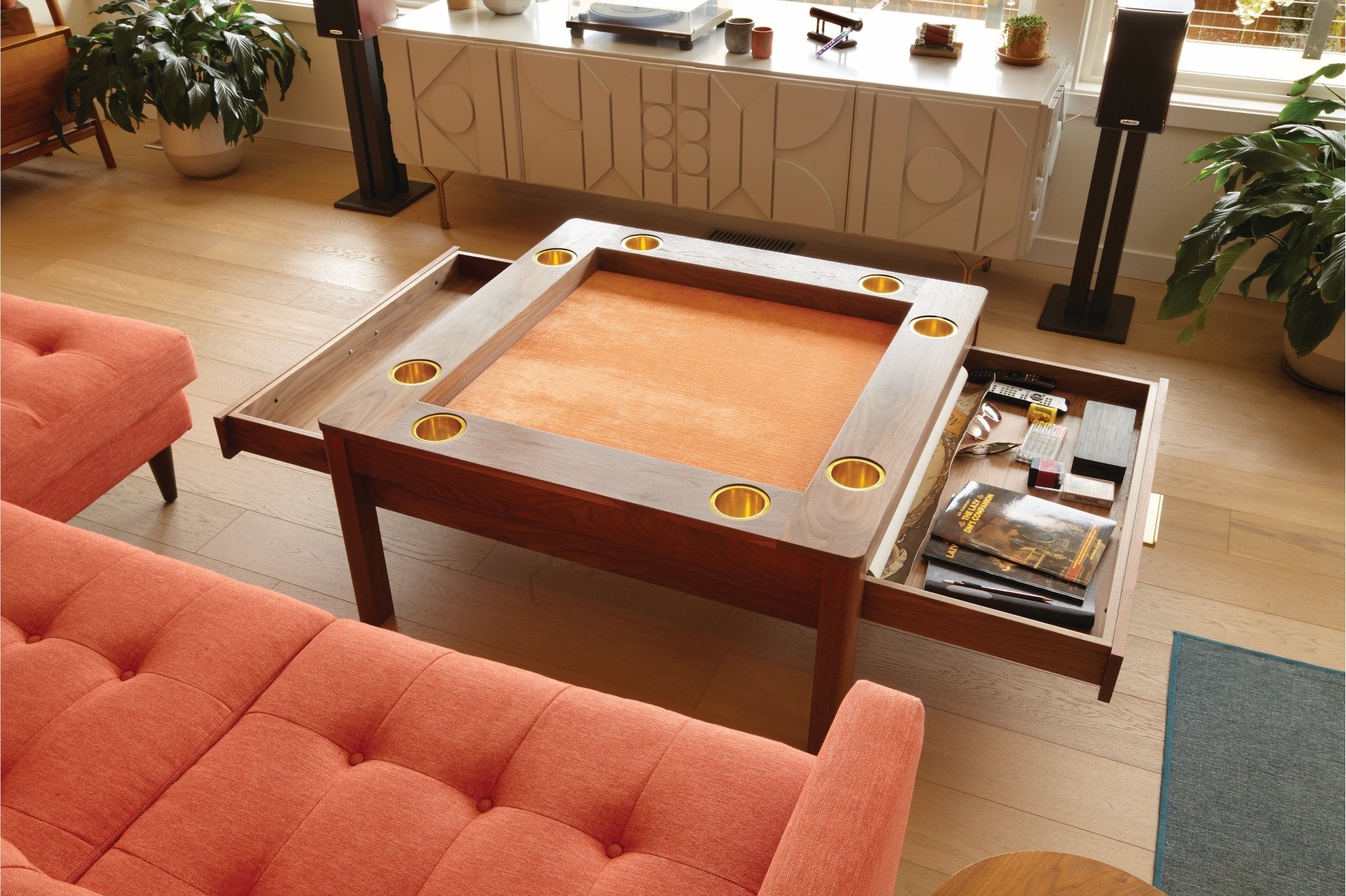
Paper needs space too. Codex, datacards, secondary objective cards, and a tape measure add up to more surface than most people budget for. A DM shelf mounted on the rail keeps that stack off the play area entirely.

A handful of dice thrown across an open board takes out terrain and knocks models off their bases, which is why players want a rolling area off the battlefield. Recessed dice bins with covers solve it at the table edge, and close flush when the game is over.
Budget an extra 6 to 12 inches of surface on each side beyond the marked battlefield, or accept that a side table is doing the job. That pushes a 44" x 60" battlefield toward roughly 56" x 72" of physical tabletop.
Cup holders, rails, and player stations live in that same margin, which is what the rest of the Dresden accessories are for.
How Much Room a Warhammer Table Actually Takes
Table footprint plus walking clearance on every playable side decides whether the table can exist in your house.
Plan on 30 to 36 inches of clearance per side. That is enough to walk the perimeter, lean in to move models, and pull a chair out without hitting a wall.
|
Surface |
With 30" clearance per side |
Notes |
|---|---|---|
|
Bare 44" x 60" battlefield |
~8'8" x 10' |
Minimum viable, no staging margin |
|
56" x 72" table (44x60 plus margin) |
~9'8" x 11' |
Comfortable Strike Force setup |
|
72" x 48" table (classic 6x4) |
~9' x 11' |
Fits more systems |
Reach is the second limit. Most adults can cover 24 to 30 inches across a table without leaning on it. A 48-inch width is reachable from both sides. A 64-inch-wide dining surface is not reachable from one, which matters when a unit ends its move in the far corner.
Height changes reach as well. Standard dining height sits around 30 inches, and our own tables come in at 30 3/8 inches, which is where the two-sided reach math above holds. Taller gaming heights near 36 inches shorten how far you can comfortably lean.
The clearance and reach rules here generalize past 40k, and our guide to board game table size works the same math for a group playing Euros and dexterity games.
Getting the table into the room is where plenty of plans fall over. A fixed 6x4 top will not go through a standard 32-inch doorway, which is the whole reason modular and knock-down construction exists. The Dresden ships in pieces sized to clear a 32-inch door and assembles in the room it is going to live in.
Lighting is a small thing that shows up fast. A single overhead fixture directly above a terrain-dense board throws long shadows across ruins, and two lower sources at the sides read better.
Measuring Your Space Before You Commit
Tape the intended footprint on the floor before anything gets ordered or built. Include the clearance ring, then walk the whole perimeter at a normal pace.
Test reach at the height you will play at. Stand at the taped edge with a tape measure and see where your hand stops without your ribs touching the table.
Check chair swing if the table doubles as dining furniture. A chair pulled out and sat in takes about 36 inches from the table edge.
Verify the delivery path as well as the destination room. Front door, stair turns, hallway width, and door frames all get measured before the room does.
Table Formats: Dedicated, Convertible, and Temporary
Living situation decides this more than budget does.
A dedicated wargaming table gives you a full-size surface with terrain left standing between sessions. It also asks for a room that will never be anything else.
A topper on an existing dining table is the cheapest entry. The table underneath caps the size, and the topper comes off and goes somewhere for every meal.
Folding and modular tables store away, which is the point of them. Seams and slight movement in the legs affect where terrain sits, so heavy pieces want a solid section.
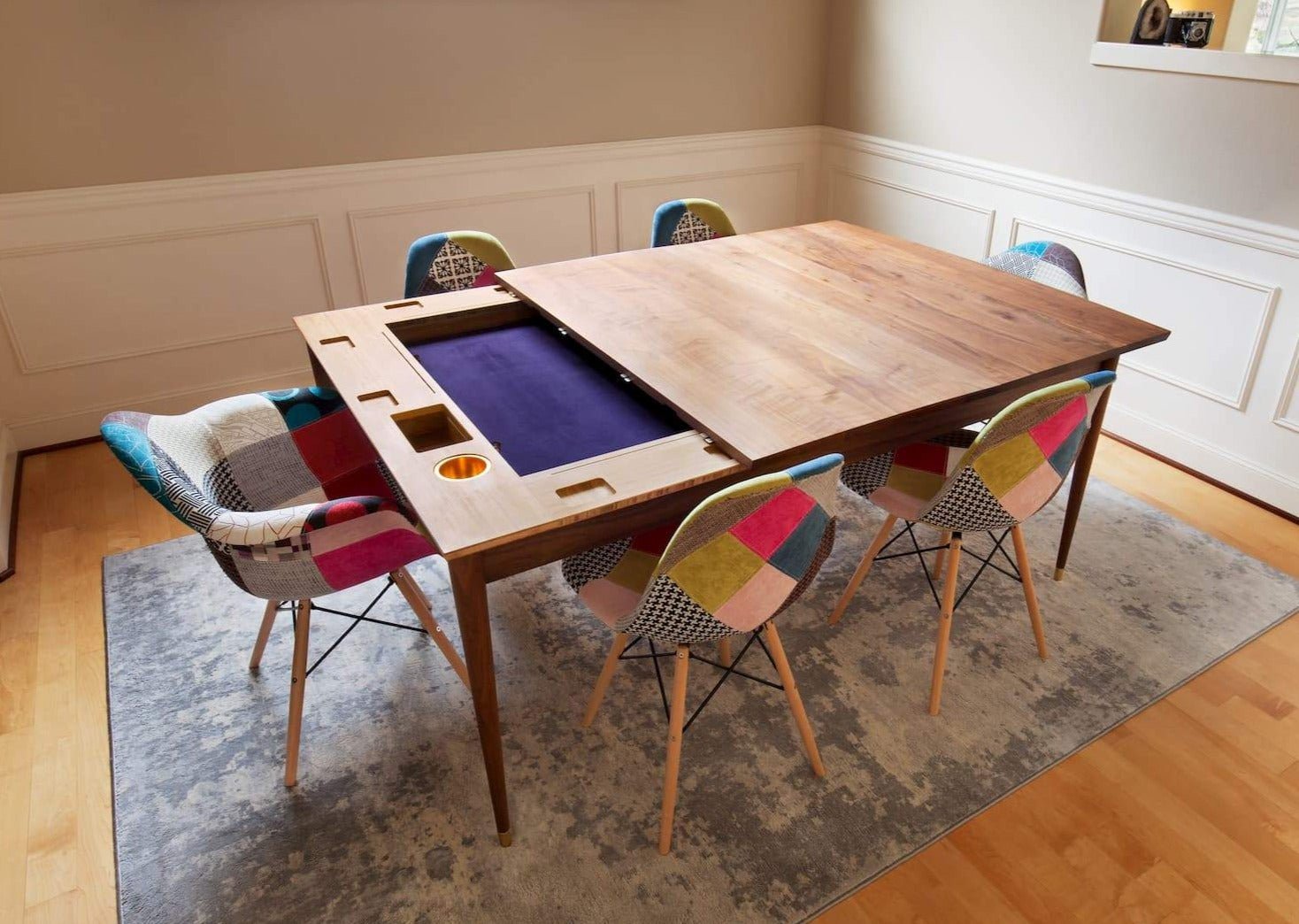
A convertible dining table hides the play surface under removable leaves, so the room reads as a dining room the rest of the week. The mechanical detail that matters most in this format is the vault.
The recessed area is always smaller than the dining top above it. That makes the vault dimension the one to read against battlefield dimensions in any convertible design, whoever builds it.
Our own Dresden makes the point concretely.
|
Configuration |
Game vault |
Dining surface |
Takes a 44" x 60" battlefield? |
|---|---|---|---|
|
Standard |
54" x 36" |
78" x 52" |
No |
|
XL |
66" x 36" |
90" x 52" |
No |
|
Battleground |
72" x 48" |
96" x 64" |
Yes, and the classic 6x4 exactly |
Both the Standard and the XL vaults are 36 inches wide, so neither fits a 44 x 60 battlefield inside the recess. They play Combat Patrol and Incursion on the official 44" x 30" board, along with Kill Team, Spearhead, and most board games. The Battleground configuration is the 40k size, matching a 6x4 board to the inch.
Vault depth on all three is 3 1/4 inches, which clears infantry and most ruins with the leaves on. Super-heavies and flyers on flight stands stand taller than that.

When the leaves come off for a game, they need somewhere to go. A leaf keep holds them upright and clear of traffic instead of leaning against a wall for six hours.
If you are weighing the format itself, our comparison of a dedicated game room table against a convertible dining game table runs the trade-offs in full.
DIY vs. Buying a Table
Plywood on a 2x4 frame hits any size target cheaply, and people have been building them for decades. They are heavy, awkward to move alone, and they look like what they are.
Cost is one axis of that decision. Storage is another, and so is whether the surface has to stop being a game table when guests arrive. A purchased table makes more sense in shared rooms, apartments, and any house where the furniture answers to more than one person.

Terrain Density and How It Changes Effective Size
Two tables with identical dimensions play differently depending on what is standing on them. Competitive 40k expects roughly 30 percent terrain coverage, using the standard tournament layouts as the reference.
Dense terrain compresses the open lanes, which makes a 44-inch width feel tighter than the number suggests. Tall line-of-sight blockers matter more on a narrow board than a wide one, since there is less room to go around them.
Terrain also has to live somewhere between games. Ruins take more shelf volume than armies do. Our board game shelves were sized for boxed games, and they hold terrain trays and foam cases equally well.
Common Questions About Warhammer Table Size
How big of a table do I need for Warhammer?
A flat surface of 44 inches by 60 inches plays a full 2,000-point game. Adding 6 to 12 inches of margin on each side for dice, casualties, and books puts the physical table nearer 56" x 72".
Is a 6x4 table still fine for 40k?
Yes. A 72" x 48" table hosts a 44 x 60 battlefield with room to spare, and it covers The Old World, Bolt Action, and other systems that still use the classic size.
What is the table size for a 1,000-point Warhammer game?
Incursion games at roughly 1,000 points use a 44" x 30" battlefield, the same board as Combat Patrol. The full 44" x 60" size comes in at Strike Force, the standard 2,000-point game.
Did 11th Edition change the table size?
No. The June 2026 edition kept the existing battlefield dimensions and rewrote how terrain works instead. Your mats and your table plan carry over.
How tall should a Warhammer table be?
Standard dining height, around 30 inches, suits seated play and keeps a 48-inch width within reach from both sides. Bar height near 36 inches suits standing play and shortens your reach across the board.
How much room do I need around the table?
Thirty to thirty-six inches on every playable side. That covers walking the perimeter, handling models at the far edge, and pulling out a chair.
Do I need a gaming mat, or is a bare tabletop okay?
A bare surface plays fine. A mat gives you printed dimensions to measure against, a little grip under bases, and an easy way to switch between board sizes on one table.
Where Most Players Land
The battlefield question has a short answer: 44 inches by 60 inches for a standard game, with 6x4 as the wider option that covers more systems.
The room question decides what you can buy. It comes down to roughly three feet of clearance on every side, a reach that gets you to the far edge, and a delivery path wide enough to get the table inside.
Measure the room first, then pick the surface that fits it. A table sized for the game you play most weeks, in a room you can walk around, gets used far more than an ambitious one that makes the space unusable.