Board Game Storage Ideas That Keep Your Collection in Rotation
The best shelves for board games are deep enough to hold a standard box without overhang, tall or adjustable enough for oversized boxes, and stiff enough not to sag under a full row of games. Get those three right and most collections are well served.
Those details matter because a game you can see and reach on a weeknight is a game that gets played. A shelf that buries your favorites behind a stack, or bows in the middle, pushes the hobby back toward the closet.
A collection of twenty games and one of three hundred need different things from a shelf, and so does a dedicated game room compared with a living room wall.
We build our board game shelves for the living-room end of that range, where the shelf is on view every day and has to look like furniture.

What Makes a Good Board Game Shelf
Four things decide whether a shelf works for games: depth, spacing, how much weight each shelf carries, and whether you can add to it later. Bookcases built for paperbacks often miss on the first two.
Depth. Most standard game boxes run roughly 11 to 12 inches square, so a shelf needs at least that much depth to hold them without an edge hanging over the front. Many ready-made bookcases are shallower. On a deep enough shelf you can also run boxes two rows deep, with lesser-played titles in back.
Spacing. Game boxes come in every size. Big-box titles, deluxe editions, and expansions stand taller than a standard box, and fixed shelves force you to lay those flat or store them somewhere else. Adjustable shelf pins, or a unit with at least one tall opening, keep the whole collection in one place.
Weight. Games are heavier than they look, and a full shelf of them puts steady load on the middle of each board. Particleboard and thin laminate shelves bow over time, especially on wide spans. Solid wood, plywood, and steel hold their line far longer, and shorter spans help any material.
Room to grow. Collections expand. A modular system you can extend with matching units handles that better than a one-off bookcase, which leaves you hunting for a second piece that fits beside it a year later.
A quick board game shelf checklist
- At least 12 inches deep, more if you want to run boxes two rows deep
- Adjustable shelves, or at least one tall opening for oversized boxes
- Solid wood, plywood, or metal shelves, or short spans if the shelves are laminate
- Room to add matching units as the collection grows
Upright or Stacked? How to Store Board Games on a Shelf
Store most board games vertically, standing on edge like books. You can pull any single title without lifting the three boxes on top of it, and every spine reads at a glance, so picking tonight's game takes seconds.
The catch is what happens inside the box. When a box stands on its side, loose cards and tokens slide to the bottom edge and mix together. Bag components by type, keep the lid snug with a box band, or use a tray insert that locks pieces in place, and upright storage works fine.
Stacking still has a place. Small, sturdy boxes that rarely come off the shelf can sit in a short stack without much risk. Keep stacks to three or four boxes, and put the games you play most where you can grab them with one hand.
The Best Shelves for Board Games, by Type
No single shelf suits every collection, so it helps to think in types. Each option below solves a different problem, and plenty of households end up with two: a workhorse unit for the bulk of the collection and something nicer for the games on view.
Cube Shelving (IKEA Kallax and Similar)
Cube shelving is the community default. An IKEA Kallax, and the many units built on the same idea, holds a standard game box upright in each cube with little wasted width. It costs relatively little, it's easy to find, and you can add a matching unit later.
Ask a room of board gamers what they use and the Kallax comes up first, which also means plenty of inserts, bins, and accessories are sized to fit it.
So is the Kallax good for board games? For a collection made mostly of standard-size boxes, yes. The limits show up at the edges: the cube size is fixed, oversized boxes won't fit, small boxes leave dead space above them, and the long shelves on wider units can bow under heavy games.
Shelf inserts and risers help with that dead space. A half-height insert splits one cube into two shorter openings, which suits small card games and keeps them from getting lost at the back.
Adjustable Bookcases (IKEA Billy and Utility Bookcases)
Adjustable bookcases, such as an IKEA Billy fitted with extra shelves or a basic utility bookcase, handle mixed box sizes well. Move the pins to fit a row of tall big-box games on one level and a row of small card games on the next, and very little height goes to waste.
Check the depth before buying. Many bookcases were designed for books and come up short of a standard game box, including the Billy, which leaves boxes sticking out past the front edge. Measure a few of your most common boxes and compare them with the listed interior depth.
Which IKEA shelf works best for board games depends on your boxes. The Kallax is the easier fit for a collection of standard-size games, while an adjustable unit like the Billy does better with a mix of tall, oversized, and small boxes, provided the depth works for you.
Metal Shelving
Steel utility racks, the kind sold for garages, carry more weight per shelf than almost any other option, come in generous depths, and cost little for the number of games they hold. For a very large collection, they're the most practical way to keep everything upright and in one place.
The tradeoff is looks. Wire and steel read as industrial, which suits a dedicated game room, basement, or closet better than a living room. Small boxes can also tip into the gaps on wire shelves, so a sheet of plywood or a solid shelf liner on top helps.
Modular Board Game Shelving Systems
Several gaming-furniture makers build modular shelving specifically for board games. These units are sized around game boxes from the start, with the depth and spacing a collection needs, and you add matching sections as the shelves fill.
Expect to pay considerably more than for flat-pack furniture, and expect a wait, since many are built to order. For a large collection in a room you care about, the fit and finish can be worth both. Apply the same checks you would to any shelf: solid wood or plywood construction, enough depth for your boxes, and spacing that fits your tallest games.
Display Shelves for Your Favorite Games
A display shelf holds the handful of games you want people to notice: a beautiful edition, a family favorite, a grail game you tracked down for years. It shares space with books, plants, and whatever else makes the room feel like yours.
Our Eolian is made for that role. It's a bamboo display shelf built from solid bamboo with dado joinery, so it arrives ready to stand with no assembly. It measures 75¼" x 41½" x 11½", comes with or without legs, and sells for $1,250.
At 11½ inches deep, the Eolian is shallower than most cube units, and larger game boxes will reach its front edge, so it isn't meant to hold a whole collection. It fits best in a living or dining room near your game table, with a few favorite games displayed alongside the pieces you'd rather see every day.
Closed Cabinets
A board game cabinet puts the collection behind doors, which keeps a living room or shared family space calm and neutral. When friends come over for dinner, the games are simply out of view.
The cost is that out of sight often means out of mind, and games behind a closed door come out less often than games on an open shelf. If you go with a cabinet, keep your most-played titles on an open shelf nearby so a weeknight game is still one step away.
How to Choose the Right Shelf for Your Collection
Four questions about your own situation narrow the options quickly.
How big is the collection? A dozen games fit almost anywhere, so you can choose on looks. A large, growing collection needs capacity and room to expand, which points to cube shelving, metal racks, or a modular system.
What kind of space is it? A dedicated game room or closet can take industrial shelving. A living room asks the shelf to read as furniture. In a small apartment, build upward, and consider a cabinet or closet so the collection doesn't take over the room.
Display or hidden? If you like box spines on view as a standing invitation to play, choose open shelving. If you'd rather the room stay neutral, choose a cabinet and keep a small open shelf for favorites.
How often do you play each game? Put weekly games at eye level and within arm's reach. Rarely played titles can go high, low, or in the back row of a double-depth shelf.
Some collectors take games out of their original boxes altogether and store them in matching bins or deck boxes. Uniform containers pack tighter and give a shelf a clean, cohesive look, which matters most when space is short.
Original boxes keep the box art as a cue when choosing, hold the trays that help with setup, and keep a game complete if you ever sell it. We keep original boxes for most of our own games, but there is no single right answer, and plenty of large collections run the other way.
Board Game Storage Ideas Beyond the Shelf
Shelving handles most collections, but a few other board game storage ideas help when wall space runs out or when the games need to live closer to where you play.

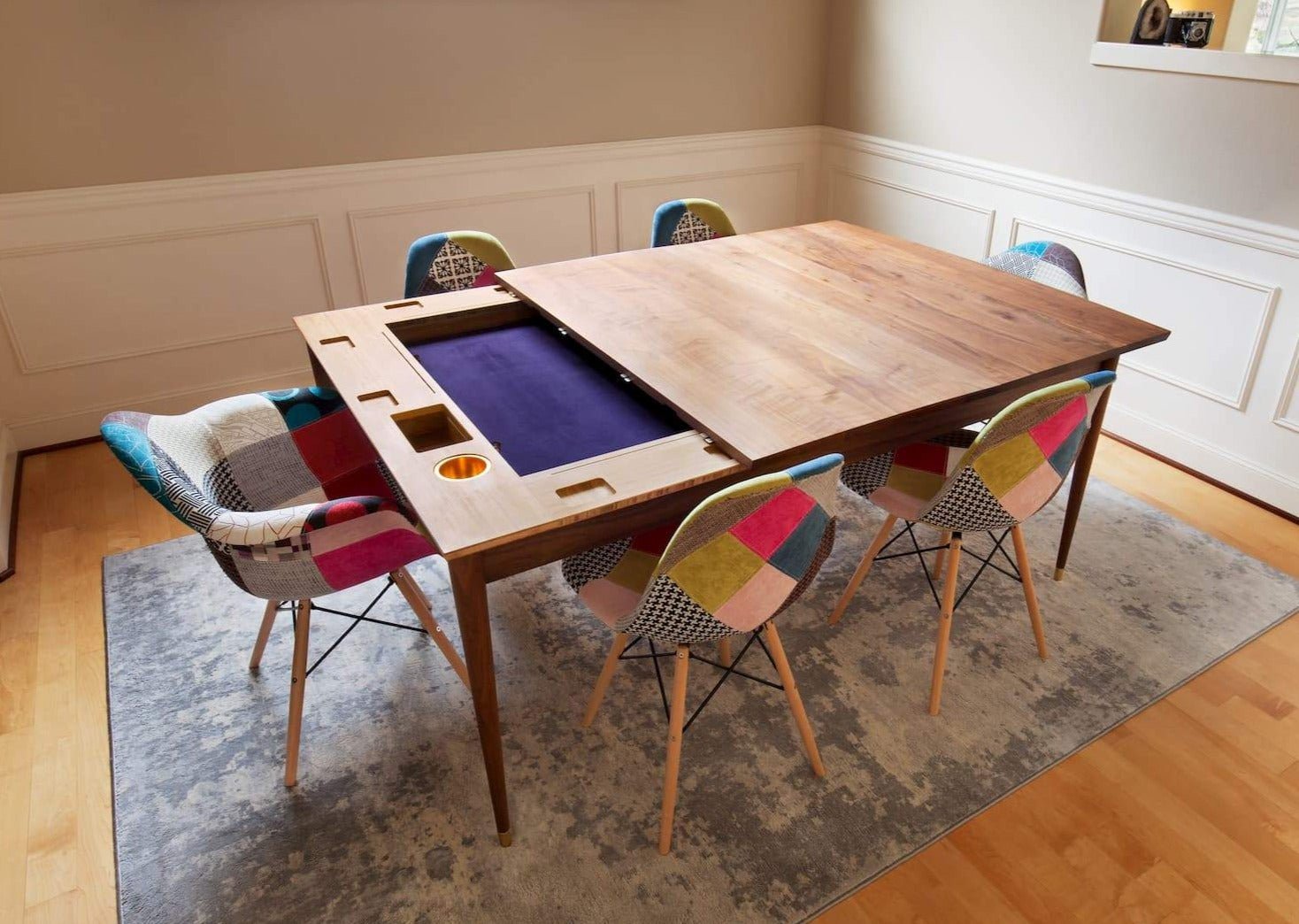
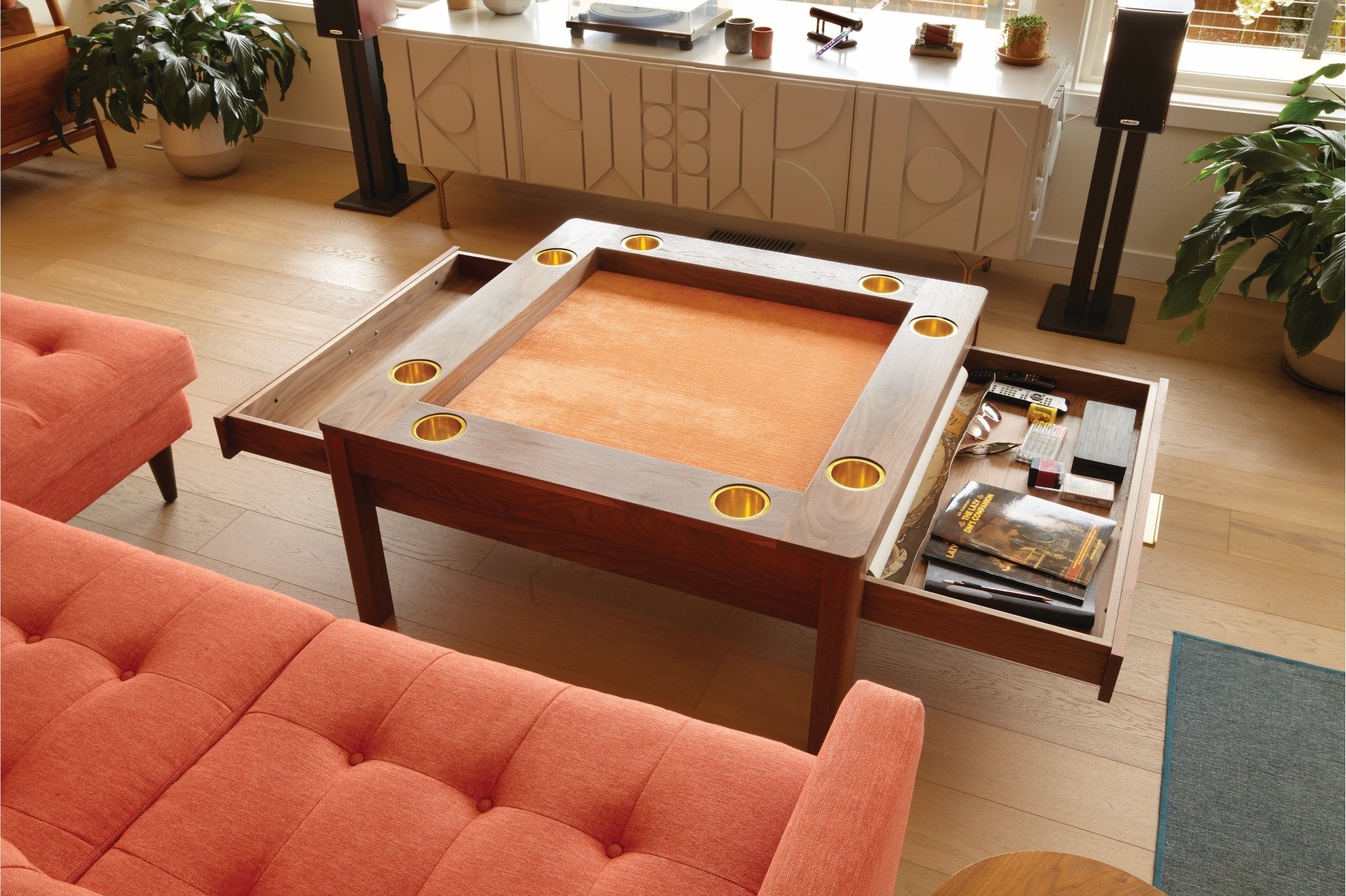
Furniture with built-in storage keeps games right beside the table. Our Firefly is a coffee table with hidden game storage, with drawers for boxes and a recessed play area under its removable top. The Dresden does the same at dining-room scale, as a board game dining table with storage for the games you reach for most.

In a small apartment, look for space nobody else is using. Slim bins slide under a bed or sofa, over-door racks turn the back of a closet door into storage, and smaller boxes can nest inside larger ones. Our small-space furniture ideas go further on rooms that do several jobs.
If you'd rather build, build to the box. Shelves cut to the depth of a standard game box, or twice that for two rows, use a wall far better than a bookcase made for paperbacks. For odd alcoves and big collections, a simple custom build often fits where nothing ready-made will.
Organizing the Pieces Inside Each Box
Good storage inside the box is what makes upright shelving work, and it cuts setup time too. Zip or mesh bags keep tokens, meeples, and cards sorted by type, and they hold everything together when a box stands on edge.
Clear divided containers suit games with lots of small pieces, since you can see what's inside and set the whole tray straight on the table. Foam inserts protect higher-value games and ones you carry to a friend's house, but they cost more and take time to fit, so save them for the games that travel.
The best storage containers for board games go from box to table without a round of sorting first. If a container makes you dump and pick through pieces every session, swap it for one that doesn't.
Keeping Your Shelves Organized
Group games on the shelf by player count, play time, or type. When someone asks what plays in an hour with four people, the answer is one cube you can point to.
Label shelves or bins so every game has a fixed home and anyone in the house can put a title back without asking. A simple collection log on a spreadsheet or index cards, noting player count and play time, makes the weekly what-should-we-play question quick to settle.
Keep your most-played titles at eye level, and return pieces to their bags and trays at the end of each night before the box goes back up. For the rest of the room, our game room organization ideas cover the space beyond the shelves.
The Shelf That Gets Your Games Played
A good board game shelf is deep enough for your boxes, adjustable or tall enough for the oversized ones, and sturdy enough to stay flat. Cube units cover most standard collections, adjustable bookcases handle mixed sizes, metal racks carry very large ones, and a cabinet keeps a shared room calm.
A month into the new setup, check one thing: are you playing more of your games than before? If you're adding a piece for the games you want on view, our board game shelves are made for that spot in the room.