Classic board games are the ones still in print decades after release, still pulled out at family gatherings, and still easy enough to teach a grandparent and a ten-year-old at the same table. Some are thousands of years old. Others arrived in the last thirty years and already belong in the same conversation.
We've organized our picks for the best board games of all time by decade, with three to five games for most eras and the release year for each. Where a game's history is murkier than the box suggests, we say so.
Quick List: The Best Classic Board Games at a Glance
If you only need ten names, start here:
- Chess (modern rules around 1475): the strategy game every other strategy game gets measured against.
- Backgammon (ancient roots, modern form in the 1600s): dice, racing, and more decision-making than it first appears.
- Monopoly (1935): the property-trading game nearly every household has owned at some point.
- Scrabble (1948): the word game that turned vocabulary into a competitive sport.
- Clue (1949): the murder mystery that made deduction a family activity.
- Risk (1957): world conquest, dice battles, and alliances that rarely last.
- The Game of Life (1960): careers, kids, and a spinning wheel that decides a lot.
- Trivial Pursuit (1981): the trivia game that swept American living rooms in the 1980s.
- Catan (1995): trading and building on a hex-tile island, and the start of the modern hobby.
- Ticket to Ride (2004): cross-country train routes that take five minutes to learn.
So what is the number one board game? It depends on how you measure. Chess has been played the longest and in the most places. Monopoly is the best-known brand-name board game in the world. Among modern hobby games, Catan holds that spot.
What Makes a Board Game a Classic?

Every game on our list clears four bars:
- It's still in print, so you can buy a copy today without hunting estate sales.
- People still play it, not only keep it on a shelf for nostalgia.
- You can teach it in a few minutes to someone who has never seen it.
- It shaped the games that came after it.
"Best" is always a blend of sales, staying power, and design, and we've weighed all three. Where we mention sales, keep in mind the figures come from publishers and are estimates, often counted in different ways from one company to the next.
The games that last also cross generations easily. A grandparent who learned Scrabble in the 1950s can sit down with a grandchild who learned it last week, and the rules haven't moved. That shared starting point is a big part of why these boxes keep getting passed down instead of given away.
The Oldest Board Games: Where It All Started
The oldest board game we know of is Senet, played in Egypt from around 3100 BC. Boards turn up in tombs, including Tutankhamun's, and the game carried religious meaning about the journey to the afterlife. No one has the original rules, but modern reconstructions make it playable.
The Royal Game of Ur, from Mesopotamia around 2600 BC, has a better paper trail. A cuneiform tablet preserved enough of its rules that scholars have reconstructed a race game you can play tonight. Backgammon descends from this family of race games, by way of the Roman game tabula and the Persian game nard.
In China, Go has been played for more than 2,500 years on a grid of black and white stones, and it's still played seriously today. Liubo, another early Chinese game, was popular for centuries before its rules were lost. Mancala, a family of count-and-capture games with seeds or stones, has deep roots across Africa and the Middle East.
Nine Men's Morris, a game of forming rows of three and capturing pieces, was popular across the Roman world and medieval Europe. Its boards are still visible scratched into old stone, including the cloister benches of some English cathedrals.
Chess traces back to chaturanga in India around the 6th century, then spread through Persia and into Europe. The modern rules, with the powerful queen and long-moving bishop, settled in the late 1400s. Checkers, or draughts, took its familiar form around the 12th century, when players brought an older game onto the chessboard.
Classic Board Games Before 1930
Before board games came from big toy companies, many were adapted from older traditions or sold by small inventors. A few from this era are still on store shelves.
The Landlord's Game (patented 1904). Lizzie Magie designed it to show how land monopolies concentrate wealth. It's the direct ancestor of Monopoly, which didn't appear under that name until the 1930s, so Monopoly gets its spot in the next section.
Parcheesi (US trademark 1874). An Americanized version of pachisi, the cross-and-circle race game from India. Four players, four pawns each, and plenty of chances to send an opponent back to start.
Chinese Checkers (1892). It began in Germany as Stern-Halma, a star-shaped version of an older game called Halma. It picked up the name Chinese Checkers in the US in the late 1920s, even though it isn't Chinese and isn't checkers.
Bunco (19th century). Strictly a dice game, played in rounds at several tables at once. It came back in a big way in the 1980s as a neighborhood party game, and plenty of groups still meet monthly for it.
Board Games of the 1930s and 1940s
The Depression and the war years produced an unusual number of games still sold today. Families were home more, money was tight, and a board game offered a lot of evenings for the price.

1930s: Monopoly, Sorry!, Scrabble
Monopoly (1935). Parker Brothers bought the game from Charles Darrow and released it in 1935, and it sold hundreds of thousands of copies within the year.
It's the best-known board game in the world, and it's how many of us first learned about rent, mortgages, and holding a grudge. You can see where it still leads in our map of the most popular board game in each state.
Sorry! (1929 in England, 1934 in the US). Another descendant of pachisi, built around the pleasure of bumping an opponent back to start. Younger players pick up probability and counting without noticing, and adults still enjoy the swings of a close game.
Scrabble (1931 to 1948). Alfred Butts invented the game in 1931 as Lexiko, reworked it as Criss-Crosswords in 1938, and sold the rights to James Brunot, who renamed it Scrabble in 1948. Sales took off in the early 1950s, and it's been a fixture on family shelves ever since.
1940s: Clue, Candy Land, Chutes and Ladders
Clue (1949). Anthony Pratt, an English musician, designed it during the war, and it launched in 1949 as Cluedo in the UK and Clue in the US. It's widely credited with starting the deduction genre, and its logic of eliminating suspects, weapons, and rooms holds up with the right group.
Candy Land (1949). Eleanor Abbott created it while recovering from polio, as a game children in the hospital could play. There's no reading and no strategy, which is exactly why it's the first board game for so many families.
Chutes and Ladders (1943). Milton Bradley's American version of snakes and ladders, a game with roots in ancient India. It teaches counting and turn-taking, and every adult remembers the long slide down from near the top.
Board Games of the 1950s and 1960s
Postwar homes had more leisure time and new plastics to make games from. Toy companies started building games around family evenings and television tie-ins, and several from these two decades never left the shelves.
1950s: Yahtzee, Risk
Yahtzee (1956). A Canadian couple invented a dice game on their yacht and shared it with friends. Toymaker Edwin Lowe bought the rights in 1956, reportedly in exchange for a thousand finished sets, and named it Yahtzee. It still turns up at almost every cabin and family reunion.
Risk (1957). French film director Albert Lamorisse designed it as La Conquête du Monde, and Parker Brothers brought it to the US in 1959. Long games, dice-driven battles, and alliances that fall apart right on schedule have kept it in steady print since.
1960s: The Game of Life, Twister, Operation, Battleship, Stratego
The Game of Life (1960). Milton Bradley released it to mark the 100th anniversary of the company's first game, The Checkered Game of Life. Players spin, choose careers, collect paydays, and fill their little cars with family.
Twister (1966). The game where the players are the pieces. A television appearance the year it came out sent sales soaring, and it's still the one party game where no one needs a seat.
Operation (1965), Battleship (1967), and Stratego (1961). Operation brought a buzzer and a steady hand to the table. Battleship turned an old pencil-and-paper game into plastic pegs and grids. Stratego, a Dutch design released in the US in 1961, set two armies against each other with hidden ranks.
70s Board Games
The 1970s leaned toward short, clever games you could finish in twenty minutes, often abstract and often built for two players. Many are cheap to buy, quick to teach, and still sold in nearly the same box.
Connect 4 (1974). Drop discs into the grid and line up four before your opponent does. The rules fit on the box, but winning takes a balance of offense and defense, blocking your opponent's line while building your own.
Mastermind (1970). A two-player code-breaking game with colored pegs, where one player sets a hidden pattern and the other narrows it down through logic.
Othello (early 1970s). Introduced in Japan and based on the older game Reversi, with discs that flip from black to white. It's simple to learn and hard to master, and it has its own world championship.
Boggle (1972). Shake the letter cubes, flip the timer, and find as many words as you can. A classic word game for families who already love Scrabble.
Uno (1971). Strictly a card game, invented by an Ohio barber, but it was on nearly every family table in the 70s.
80s Board Games
If you grew up in the 1980s, this is the decade most likely to bring back memories. Party games went mainstream, and a handful of fantasy and strategy games showed what was coming.
Trivial Pursuit (1981). Two Canadian friends, Chris Haney and Scott Abbott, came up with it in 1979 while playing Scrabble, and it reached the US in the early 1980s. By 1984 it had sold an estimated 20 million copies, and TIME magazine called it one of the biggest sensations the game business had seen.
Pictionary (1985). Rob Angel developed it in Seattle, turning a sketchpad and a timer into a team game. It remains one of the easiest ways to get a mixed group laughing.
Scattergories (1988). Roll the letter die, fill in categories before time runs out, and argue about whether your answer counts.
Guess Who? (1979 in the UK, 1982 in the US). Two players ask yes-or-no questions to find the mystery face. It's a first deduction game for many kids.
Axis & Allies (1981), Labyrinth (1986), and HeroQuest (1989). Axis & Allies brought large-scale World War II strategy to living rooms. Labyrinth has players shifting maze tiles to reach treasure. HeroQuest mixed miniatures and dungeon crawling and returned in a remade edition in 2021.
90s Board Games
The 1990s gave us the game that launched the modern hobby, along with a new wave of party games made for adults.

Catan (1995). Klaus Teuber's game of trading sheep, brick, and ore won Germany's Spiel des Jahres award the year it came out. Its mix of trading, building, and table talk opened the door to modern board games for millions of players, and its publisher reports more than 50 million copies sold, expansions included.
Cranium (1998). Created in Seattle, it had teams drawing, sculpting clay, humming, and answering trivia, often in a single turn. It works across ages, which made it a staple of 90s family gatherings.
Taboo (1989) and Jenga (1983). Taboo, the word-guessing game with forbidden clues, hit its stride in the 90s. Jenga, strictly a stacking game, launched in 1983 and grew into a fixture of the decade.
2000s: The Modern Classics Arrive
After Catan, designers in Europe and the US began building games with more choices per turn and less luck. Several from this decade are now as familiar at family tables as Monopoly.
Carcassonne (2000) and Ticket to Ride (2004). Carcassonne has players laying tiles to build a medieval landscape of roads, cities, and fields. Ticket to Ride asks you to claim train routes across a map with sets of colored cards. Both won the Spiel des Jahres, and both are go-to picks for introducing someone to modern games.
Pandemic (2008). A cooperative game in which everyone works together to stop four diseases spreading across the globe. It helped make co-op games a mainstream category and led to Pandemic Legacy, whose story changes the board over a campaign. For more in this style, see our list of the best cooperative board games.
Dominion (2008). The game that created deck-building. Everyone starts with the same small deck of cards and improves it over the game, a mechanism hundreds of later games borrowed.
Puerto Rico (2002) and Power Grid (2004). Two heavier strategy games that long sat near the top of hobbyist rankings. Puerto Rico is about choosing roles and running plantations. Power Grid has players bidding on power plants and buying fuel in a shifting market.
2010s: Future Classics
These games haven't had decades to prove themselves yet, but they're already showing up in homes that own only a few modern titles.
Codenames (2015). Two teams race to identify their secret agents from a grid of words using one-word clues. It won the Spiel des Jahres in 2016 and works for groups of four to eight or more.
7 Wonders (2010). Players draft cards to build an ancient civilization, and it plays up to seven people in about half an hour.
Azul (2017) and Wingspan (2019). Azul has players drafting colorful tiles to decorate a palace wall. Wingspan is a card game about attracting birds to your wildlife preserve, praised for its artwork and for bringing new players into the hobby.
Splendor (2014). A quick game of collecting gems and buying development cards, easy enough for a family and deep enough for a regular game group.
Gloomhaven (2017). A huge campaign game of tactical dungeon combat that held the top spot on BoardGameGeek's rankings for years.
Card games like Cards Against Humanity (2011) and Exploding Kittens (2015) also sold in enormous numbers this decade, though neither is a board game.
Will Any 2020s Games Become Classics?
It's too early to call, but a few recent games have the traits the older classics share: short rules, broad appeal, and groups that keep coming back to them.
- Cascadia (2021): a calm tile-and-token game about building Pacific Northwest habitats, and the 2022 Spiel des Jahres winner.
- Heat: Pedal to the Metal (2022): a racing game driven by card play and managing your engine's heat.
- Sky Team (2023): a two-player cooperative game about landing a plane without talking, and the 2024 Spiel des Jahres winner.
None of these has the sales history of the older games on this list, and none needs it yet. Ask us again in twenty years.
The Best-Selling Classic Board Games of All Time
Sales numbers for board games come from publishers, and they're counted differently from one company to the next. Treat these as reported estimates:
- Monopoly: more than 275 million copies since 1935, according to Hasbro.
- Scrabble: around 150 million sets across more than 120 countries, a figure widely reported as of 2008.
- Trivial Pursuit: more than 100 million copies across dozens of editions, according to its co-creator.
- Catan: more than 50 million copies including expansions, according to its publisher.
- Clue: one of the best-selling games of the 20th century, though published sales figures vary too widely to list with confidence.
Chess, checkers, and backgammon have almost certainly outsold all of them over time, but they're made by countless companies, so no one keeps a total.
Classic Board Games by Play Style
If you'd rather pick by the kind of evening you want, here's where the classics fall:
- Family: Candy Land, Sorry!, The Game of Life, and Ticket to Ride span preschool to grandparents. Our guide to board games for all ages has more.
- Strategy: Chess, Risk, Catan, and Power Grid reward planning. For smaller groups, see our list of 3 player board games.
- Cooperative: Pandemic, Sky Team, and Gloomhaven put everyone on the same side.
- Party: Trivial Pursuit, Pictionary, Cranium, and Codenames suit a full room. If you're planning one, here's how to host a board game night.
- Two-player: Chess, backgammon, Connect 4, Othello, and Stratego all play best head to head.
Where to Play Them
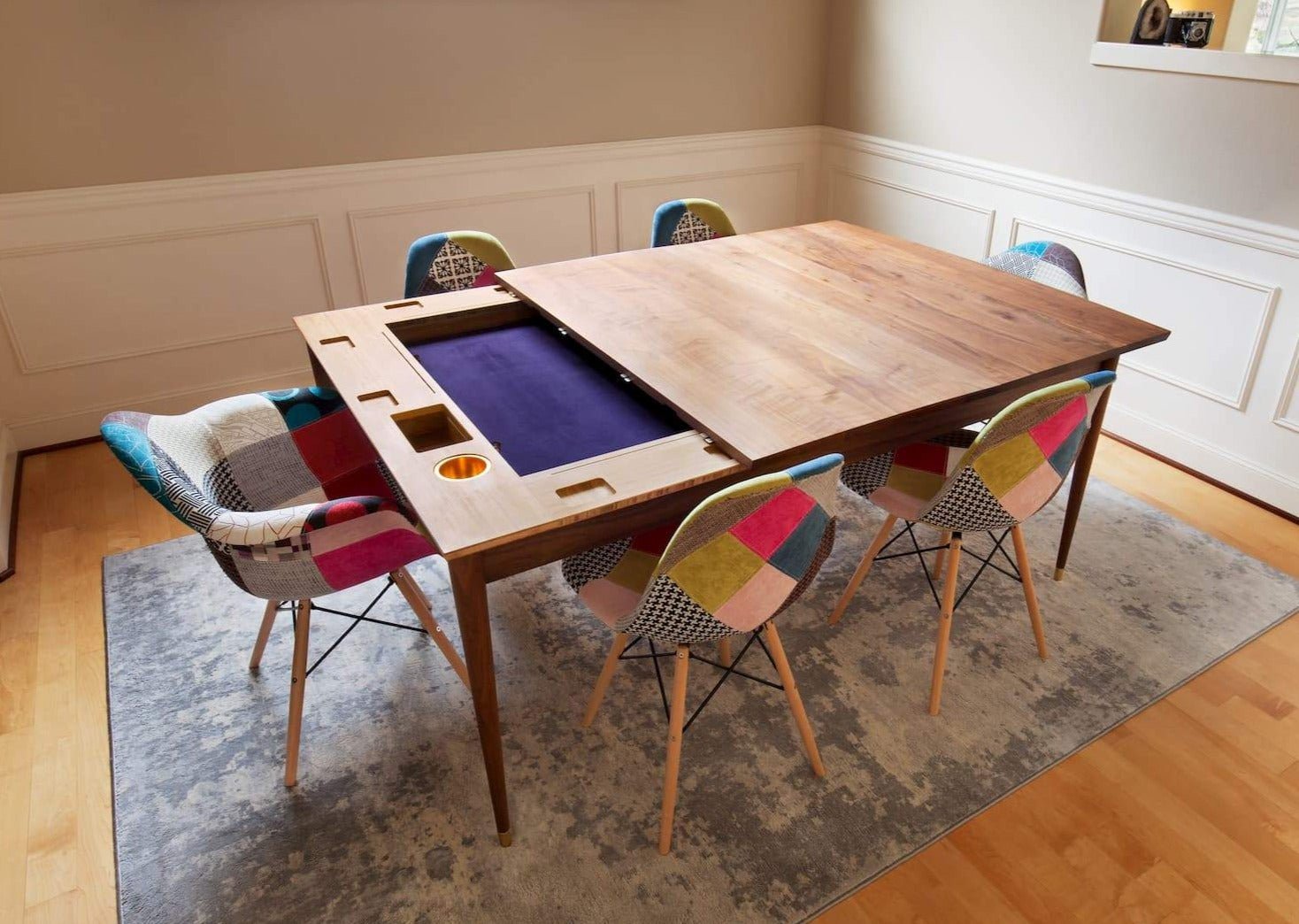
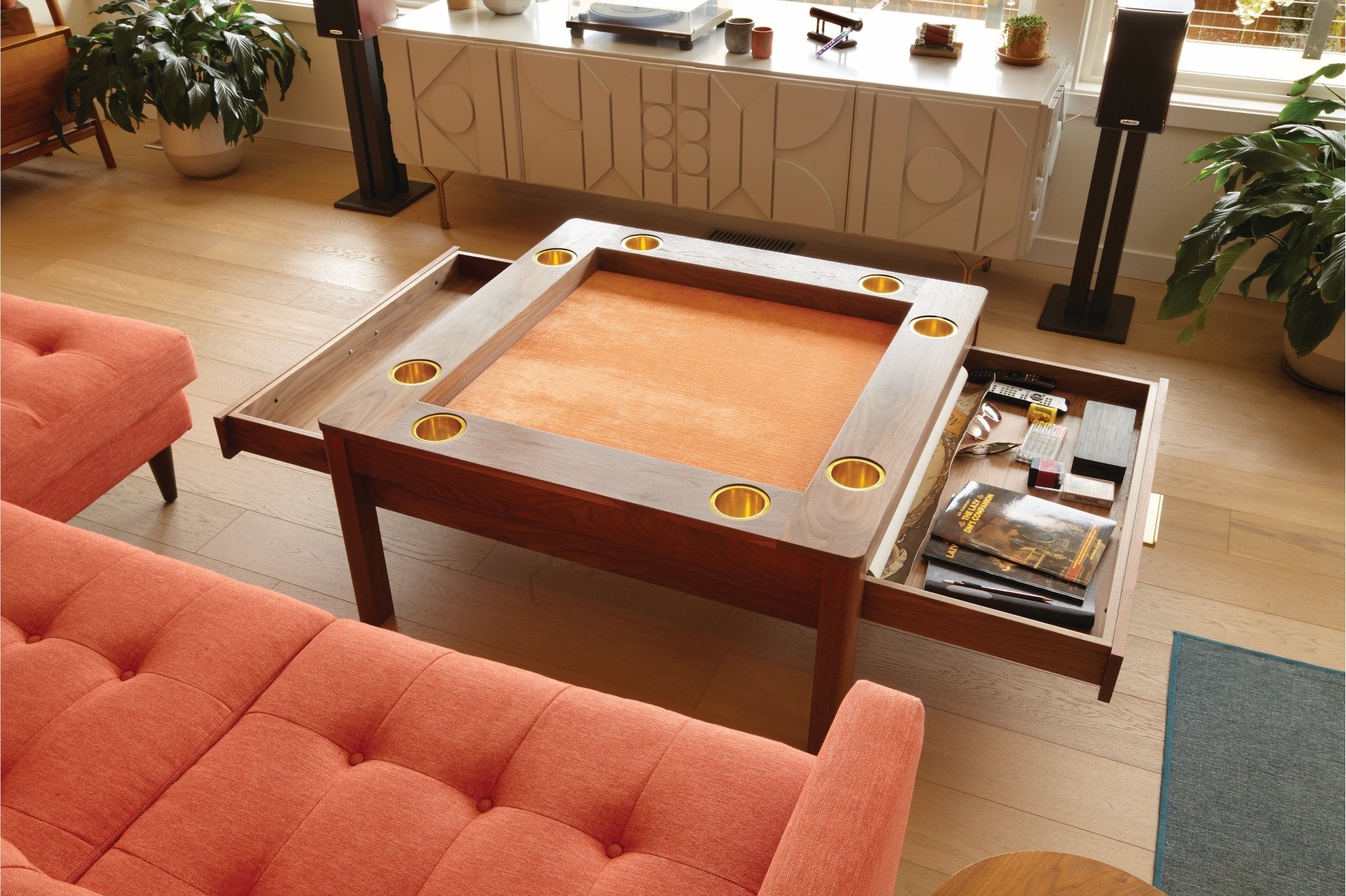
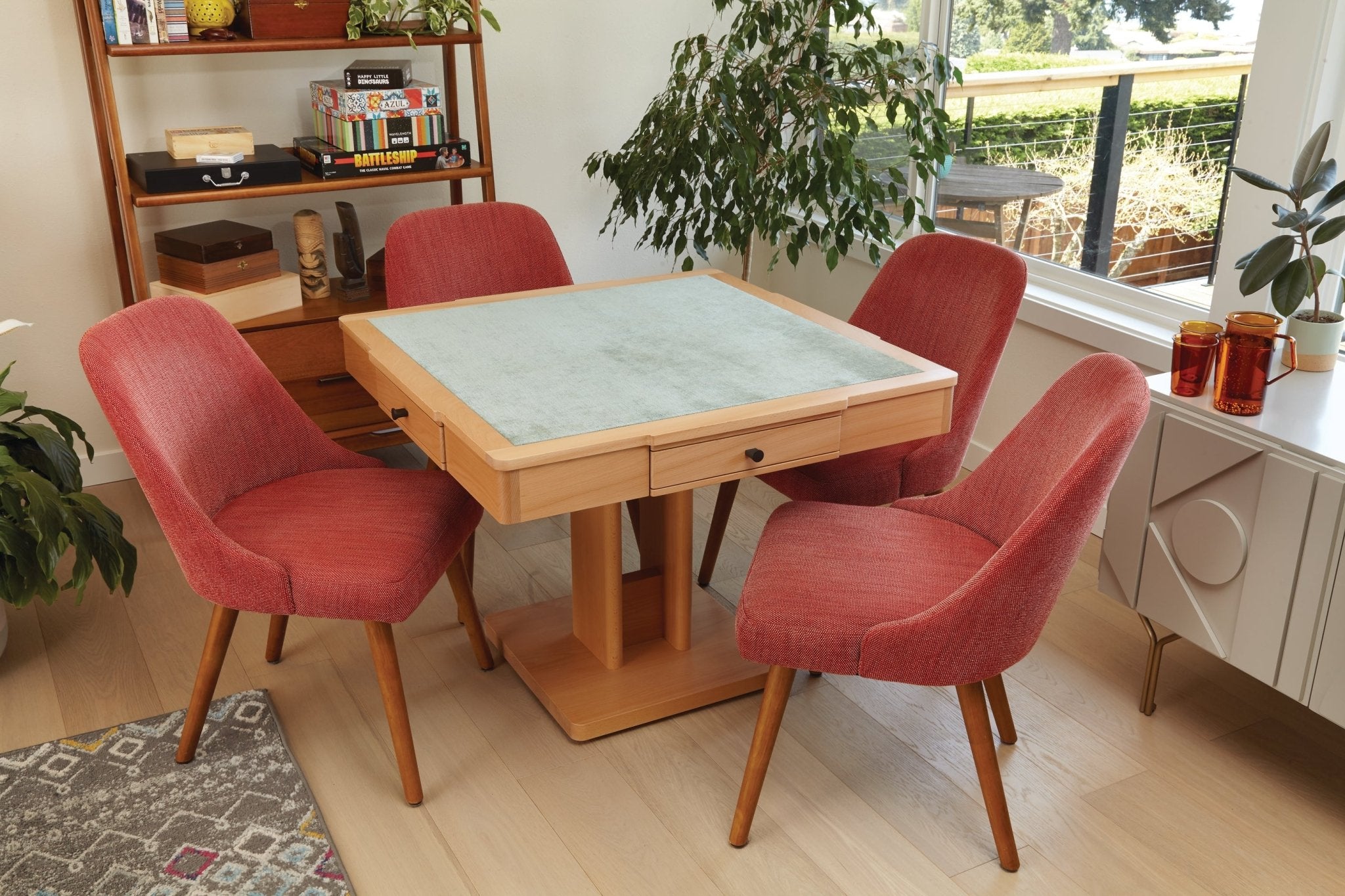
Vintage games and big family game nights ask the same thing of a room: a table where everyone can reach the board, the cards, and their drinks. A long game of Risk or Monopoly also goes better when it can stay set up through dinner.
We build board game tables for exactly that, in solid hardwood that works as everyday furniture the rest of the week.
Why These Games Keep Coming Back
Every game on this list is still in print because people keep asking for it: at holidays, on rainy weekends, and when a new generation is old enough to learn. Chess, Monopoly, Scrabble, and Catan will almost certainly still be here in another fifty years.
The 2020s contenders have a few decades to go. If one has become a regular at your table, it may be on the list next time.